
The reinsurance industry doesn’t have an actuarial problem; it has a data entry problem.
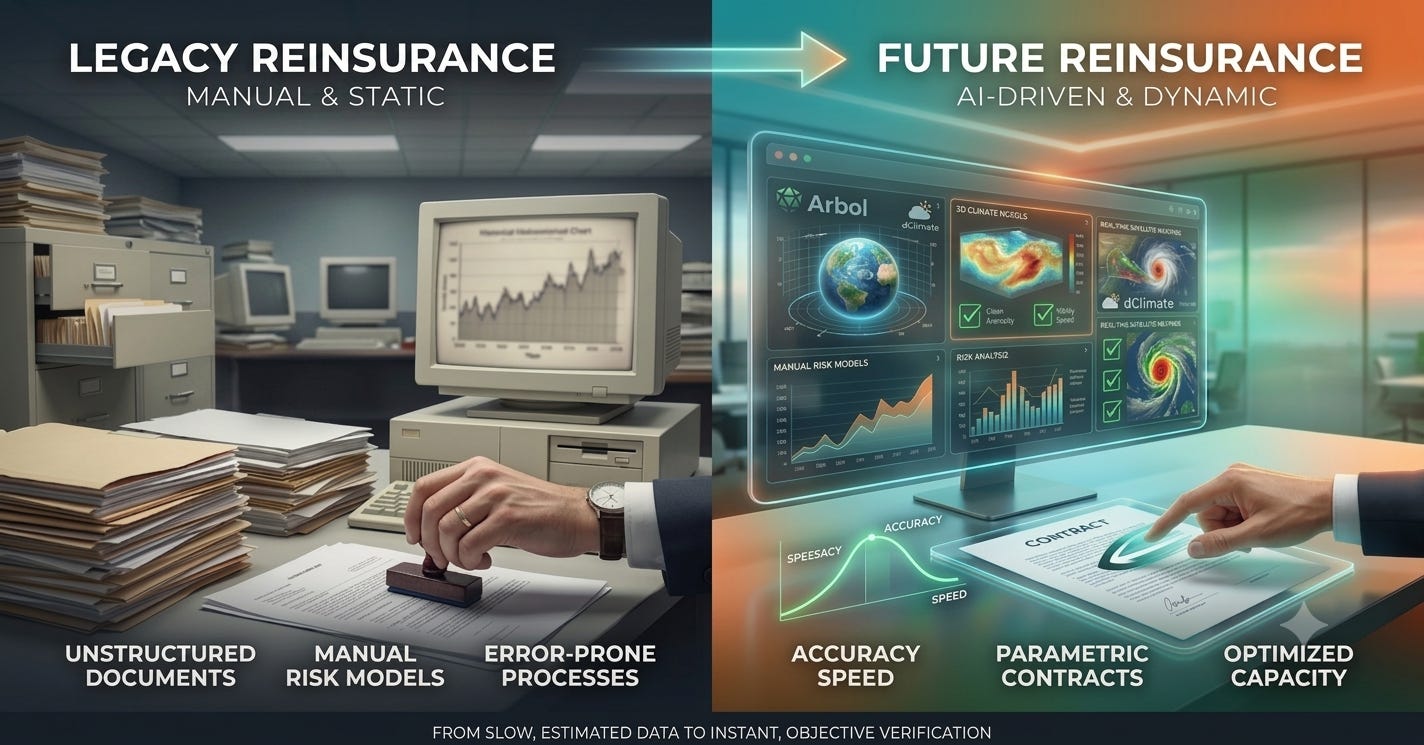
For decades, underwriting decisions have relied on manually recorded property characteristics, legacy claims histories, and historical weather patterns. The result? A massive “data-to-reality” chasm where transcription errors and outdated databases systematically misprice actual risk exposure—especially in volatile, climate-exposed lines like agriculture and coastal property.
In my latest article on Medium, I dive deep into how large language models (LLMs) are changing the risk information architecture at the source. Instead of just automating existing administrative steps, platforms like Arbol and dClimate are tackling the foundational data layer.
By simultaneously processing unstructured documents, real-time satellite imagery, meteorological station feeds, and sensor networks, AI eliminates the manual transcription bottleneck. This unlocks:
True Parametric Underwriting: Contracts that trigger automatically based on objective, real-time environmental data rather than slow, negotiated loss estimates.
Accurate Pricing for Volatile Markets: Deploying capacity where risk actually warrants it—not where a pre-2020 hurricane database suggests it should go.
Expanded Coverage Access: Reaching vulnerable markets that legacy models have previously underpriced into unprofitability or overpriced into inaccessibility.
The core takeaway? Most insurance firms are using AI to speed up the outputs (like claims dashboards), but the real revolution is happening at the input layer. When your data finally reflects the world as it is, the entire economics of risk management changes.

Read the full article on Medium to see how this architecture is paving the way for the next generation of parametric reinsurance and operational risk intelligence.
About the author
From the trading floors of Wall Street to the frontier of climate tech, Philippe Heilberg has spent his career decoding risk. He focuses on the intersection of data-driven technology and organizational resilience, offering a unique lens on how we can make smarter, more courageous decisions when the stakes are at their highest.